Logo
Douglas County ARES
Advertisement
Site Menu
Home
Contacts Menu
What is ARES
EOC\EMA
OMMRS
Red Cross
Skywarn
Documents
Operations
Training
Nets
OMMRS Steward
Member Log In
Call Sign

Password

Remember me
?
No account yet?
Search
Welcome To ARES

Amateur radio operators are able to communicate locally, regionally and internationally using a wide array of frequencies, bands and modes, many of our members are simultaneously licensed in multiple radio services. The gives us the ability to extend our global communications capabilities into other radio services that are limited to low power, line-of-site communications. Amateur Radio  is the only radio service that provides local response with global reach. As such ARES is an integral component in government emergency operations plans, severe weather spotter networks, and non-governmental agency disaster relief efforts. Join us and help make a world of difference!!

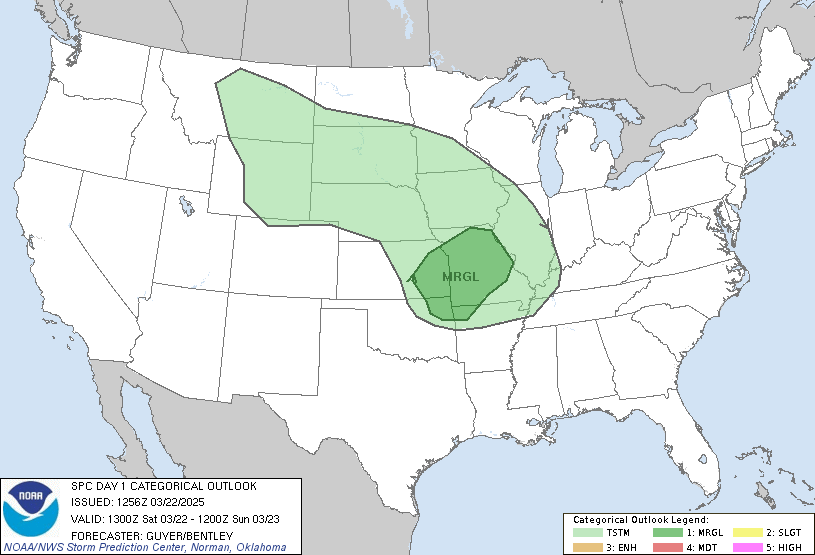
Today's Weather Outlook
Today's Outlook
Click on the map above for the latest weather info
Click on the map above for a full sized image
OMMRS STEWARD PROGRAM
As many of you know, OMMRS is a large organization with many committees and meetings. Two committees impact us, as hams, most. Those are the Communications Committee and the Communications Recruiting and Training Committee.

Communications is important in any disaster and amateur radio is a key player with the OMMRS response plan, so much so that there are more than 20 sites, spread over 7 counties that cross 2 states that have been equipped with amateur radio equipment. That is a great accomplishment and also a bit of a nightmare from an inventory and maintenance stand point. It took the Communications Recruiting and Training committee over 2 years to visit each site and inventory and check the equipment.

So out of that was born the idea to tap the volunteers that make up the amateur radio community that serves OMMRS. And so the Stewardship Program was born.

The idea is to spread the work, increase while increasing the visits and also the site staff awareness of amateur radio. Each Steward will be assigned an OMMRS site which are made up of

• Hospitals
• County health departments
• Poison center
• Red Cross Blood Services

to make regular visits that will

• exercise and inspect the equipment,
• make software updates,
• add and remove pages and supplies from the “site books”.
• document the storage location of the equipment
• note any additional items that are needed
• make sure that the station is ready all the time.

Each Steward will be given a contact name for their assigned OMMRS site, and will make a mutually agreeable time for the Steward to make the inspection. Each visit will take about an hour from set up to pack up, but might be a bit longer or shorter depending on the location. (Some stations are up all the time, others might need to be located)


We need your help to make this work.
Please sign up now as orientation will be held soon. Click the OMMRS Steward link on the main menu and complete the form. If you have not signed up at an OMMRS training meeting, please sign up using this form

FEMA Self Study

The Emergency Management Institute (EMI) offers self-paced courses designed for people who have emergency management responsibilities and the general public. All are offered free-of-charge to those who qualify for enrollment.  Each Independent Study Course includes lessons with practice exercises and a final examination. Students who score 75 percent or better are issued a certificate of achievement from EMI.

IS-100 Introduction to Incident Command System

IS-200 ICS for Single Resources and Initial Action Incidents

IS-700 National Incident Management System (NIMS), An Introduction

IS-800.A National Response Plan (NRP), An Introduction

Please notify your county EC when you have completed the course(s).


Read more...
Use of Tactical Callsigns

The use of tactical callsigns helps clarify the function of individual stations. These tactical callsigns should be used in lieu of Amateur callsigns for all initial calls and for subsequent exchanges of traffic.  However, the station operator must still follow all FCC rules when operating the station.   Your Amateur callsign should be used at the end of an exchange or every ten minutes to satisfy FCC regulation 97.119. This is easily satisfied by terminating an exchange with your tactical callsign plus your FCC-assigned Amateur callsign.

Read more...
2008 Spotter Maps
The 2008 Spotter maps are available!  You can get one on the files section of the MDARES Yahoo group, or you can sign in on this web site and go to the SKYWARN page. 
If you are an Omaha Metro Area Amateur Radio Operator and are not yet registered please click here to start the process.  You will get an email that you must respond to for the admin staff to be notified.  This is just to confirm your address.   If you need your password reset, please email


DC ARES Frequencies
Douglas County ARES is proud to use the following repeaters in the Omaha Metro Area: Thank you the the repeater owners and operators for their support of amateur radio and the service they provide to the community by allowing ARES access to their repeaters.
146.940 (-)
KØUSA
147.000 (-)
WBØCMC
145.450 (-)
KØBOY
224.940(-)
KØUSA
223.94(-)
WBØCMC
224.760 (-)
KE0SS
444.950 (+)
WBØCMC
443.775 (+)
WØEQU


ARES Related Callsigns
There are some call signs on the air that you will hear usually during ARES related nets.  You should familiarize yourself with these callsigns. 

  • NØEMA - Douglas County EOC
  • KØNCS - Net Control Station for ARES Nets
  • KØMMR - OMMRS related (Packet Only at this point)
  • KØPOT - Pottawattamie ARES
  • WØEQU - Heartland Chapter American Red Cross
  • WØNWS - National Weather Service
This is not a complete list and will be updated as we are informed of callsigns used by specific counties. 
Read more...
Served Agencies
Douglas County EMA
Omaha Metro Medical
National Disaster Medical
Red Cross
Skywarn
OPPD

Contents Property of Metro ARES.